Your search plugin is killing your store when same DB is used

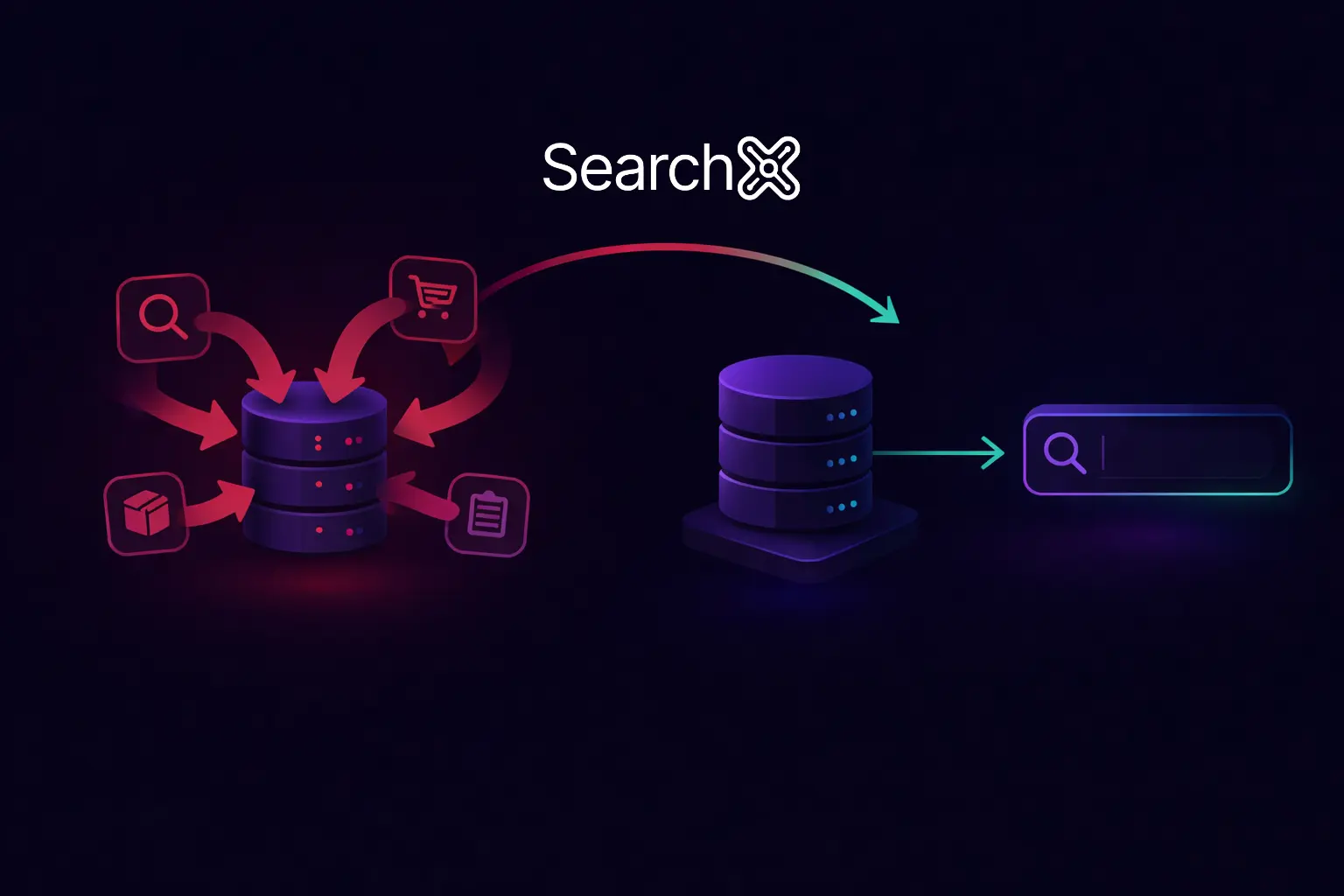
Every store owner eventually discovers their default search is broken. The obvious fix: install a search plugin. OpenCart has dozens. WooCommerce has hundreds.
They all share the same fatal flaw. They run on your database.
How Plugins Actually Work
Every search plugin does this: customer types a query → plugin builds a SQL statement → your MySQL database scans product tables, joining descriptions, attributes, options, and categories → results come back → your server renders them.
With autocomplete enabled, that's 3-8 database queries per search session. Every visitor. Every keystroke.
Now remember what else runs on that same database at that same moment: your checkout, your order management, your inventory sync, your ERP integration, your admin panel.
Search and commerce are fighting for the same resource.
The Numbers
OpenCart's default search uses LIKE '%word%' — a pattern that cannot use MySQL indexes and forces full table scans. It is benchmarked that for 1,000,000 products, OpenCart's search takes 29 seconds to return results. Even at 50,000 products, store owners on the OpenCart forums report 7+ second query times and servers that stop responding under concurrent load.
MySQL's query cache — the usual band-aid — is deprecated in MySQL 8+ and can actually degrade performance in write-heavy workloads like e-commerce.
Every enhancement makes it worse. Autocomplete? More queries. Faceted filters? GROUP BY operations. Typo tolerance? Expanded queries hitting more rows. Each feature that improves search quality adds load to the one resource you can't afford to stress.
A 1-second slowdown costs up to 7% in conversions. The "cheap" plugin becomes the most expensive line item you're not tracking.
The Right Architecture: Decouple
Modern search engines don't touch your database. They maintain a separate, purpose-built search index on dedicated infrastructure. Your product data syncs via API or feed import. All queries are served from the search index — never from MySQL.
This is how SearchX works:
- Your database handles commerce — catalog, checkout, orders, inventory, ERP. Uncontested.
- SearchX handles search — dedicated infrastructure, sub-100ms response times, AI-powered relevance, 99.9% SLA. Independent.
The integration: one JavaScript snippet. No server-side plugins, no database modifications, no PHP changes. Your store imports products via Skroutz XML, Google Merchant feed, or API — and SearchX indexes them on its own servers.
| Feature | Plugin on Your DB | SearchX (Dedicated Engine) |
|---|---|---|
| Response time | 0.4s–29s (scales with catalog) | <100ms (constant) |
| Impact on checkout | Direct — same database | Zero — separate infrastructure |
| Autocomplete cost | 3-8 DB hits per session | Zero DB load |
| Typo/multilingual | Limited SQL matching | Native AI/semantic |
| Availability | Tied to your hosting | 99.9% SLA |
| Setup | Plugin + DB mods + config | One JS snippet. 5 min. |
This is the same pattern Amazon, Zalando, and every major platform uses. They decoupled search from commerce because the alternative doesn't scale. Retailers with advanced (decoupled) search see 2x higher conversion rates than those with basic database-driven search.
The Real Cost
"But a plugin costs €30 and SearchX costs €49/month."
A store with 20,000+ products and autocomplete typically needs €50-150/month in extra hosting just to handle the search load. Add the conversion loss from slow pages and you're paying far more than €49/month — you're just not seeing it on one invoice.
SearchX at €49/month gives you dedicated infrastructure, zero database load, sub-100ms results, and AI relevance. Your servers go back to doing what they were built for: selling products.
The next time you evaluate a search plugin, ask one question: where do the queries run?
If the answer is your database, you're building a problem that gets worse as your business grows.
SearchX runs on its own infrastructure — never touching your database. 5-minute setup, €49/month, 14-day free trial. See it live · Check the docs